Showing posts with label Ecosystem Services. Show all posts

Are Socioeconomic Benefits of Restoration Adequately Quantified? A Meta-analysis of Recent Papers (2000-2008) in Restoration Ecology and 12 Other Scie

Aronson, J; Blignaut, JN; Milton, SJ; et al. Are Socioeconomic Benefits of Restoration Adequately Quantified? A Meta-analysis of Recent Papers (2000-2008) in Restoration Ecology and 12 Other Scientific Journals RESTORATION ECOLOGY, 18 (2): 143-154 MAR 2010
This paper reviews 1,582 peer-reviewed papers dealing with ecological restoration to determine how restoration scientists link socioeconomic factors into their restoration projects. Most papers do not address socioeconomic factors. Less than 10% of the papers address policy implications of restoration; only 3% of the papers evaluated projects using interviews; and most papers do not reference ecosystem services. Another key finding is that restoration projects are unevenly distributed around the globe. Almost three-quarters of the projects based in host countries with high incomes.
While I thought this paper would shed some light on how socio-economic factors are incorporated, the authors primarily made recommendations from a soapbox about how authors should use socioeconomic factors. The authors claim that conservation scientists have “not yet recognized the benefits of creating a new market for conservation.” They recommend that “Whenever possible, authors of papers and reports should be encouraged to mention or discuss specific policies, financing, and/or funding opportunities that exist to finance restoration.” Or the funding needed for restoration will not be “forthcoming.” They make no suggestions about how to address the imbalance of restoration between rich and poor countries.
In short, this paper reads like an industry propaganda piece.

Ecosystem services: from eye-opening metaphor to complexity blinder

Norgaard, R. 2010. Ecosystem services: from eye-opening metaphor to complexity blinder. Ecological Economics. 69 1219-1227.


I found this article very interesting and would highly recommend it to anyone wanting a broader perspective on the problems surrounding the valuation of ecosystem services and the structural problems of the market system in dealing with the complex ecological problems the world is facing. One of the more interesting topics of the paper is how the existing stock-flow model of valuing ecosystem services is really just one of many ways of understanding ecosystems and ecosystem function, and because it is only a single way, it leaves out other ways of understanding ecology that are just as valuable and essential. In this sense, the method of valuing ecosystems in the context of our current economic institutions tends to fail in the same way as when ecosystem services were not even considered at all in valuation assessments (although not as badly).

Other topics addressed are the shortcomings of using a partial-equilibrium framework (i.e. holding all other things equal), in the valuation of ecosystem services. Part of his reasoning being that, if you are holding all other things equal in the context of an economic and social system that is inadequate in dealing with these types of problems, then you are bound for failure. He discusses ecological valuation in a general equilibrium context as an alternative.


I suppose if one were a staunch free-market capitalist there would be ample things in this article to criticize--the author clearly believes that the economic policies stemming from this philosophy are both the cause and by nature inadequate to address the environmental and social justice problems facing the world today. But, I find it hard to argue with many of the points he raises.

Also, many of the solutions he proposes, or rather, the changes that he feels are necessary to truly begin to address the scope of the problem, are the kinds of things that just don't happen very quickly (at least not without some sort of civil war or something).

Overall, I highly recommend this paper.


Untangling the Environmentalist's Paradox: Why Is Human Well-being Increasing as Ecosystem Services Degrade?

Raudsepp-Hearne, C; Peterson, GD; Tengo, M; et al. Untangling the Environmentalist's Paradox: Why Is Human Well-being Increasing as Ecosystem Services Degrade?BIOSCIENCE, 60 (8): 576-589 SEP 10 2010


One finding of the Millenium Ecosystem Assessment was that human well-being is improving globally while at the same time ecosystem services are declining. The authors explore four possible explanations for this phenomenon: 1. the wrong metrics of human well-being were used, 2. well-being is dependent primarily on food which is increasing, 3. technology has shifted things so that humans are no longer dependent on ecosystem services and 4. there is a time lag between ecological degradation and impacts on human well being. They conclude that there is at least some evidence for hypotheses 2-4.


Pros: From Paul Erlich's Population Bomb to Bjorn Lomborg's Skeptical Environmentalist, this article touches on a recurring and problematic issue. It is well thought out and a worthwhile read.


Cons: Other than addressing potential pitfalls with ecosystem services in general, I'm not sure the connection to restoration is strong enough to warrant selection for group discussion.


Field evidence that ecosystem service projects support biodiversity and diversify options


Goldman, R.L., H. Tallis, P. Kareiva, and G. Daily. 2008. Field evidence that ecosystem service projects support biodiversity and diversify options. PNAS 105: 9445-9448

Setting aside land for conservation such as in an easement is no longer the only approach to conserve land. Ecosystem services have given conservation agencies a new approach to conserve land by being able to allocate economic and social value to these services. This is the plight that Goldman et al (2008) have proposed. They defend this argument by comparing projects within the Nature Conservancy that were either biodiversity–oriented (i.e., easements, land purchases, etc) or ecosystem service oriented. They found that ecosystem service projects attracted more funding (4 times more) and different funding (corporate vs non-profit) than simple biodiversity projects. However, the difference in funding might be a result of each approach requiring different financing, and while they reported the average financing tools they didn’t relate that to average costs for each project.
Using the project history of the Nature Conservancy to address this issue was a great idea because it allowed the authors to evaluate projects that spanned multiple areas outside the United States, and it provided some good insight into the added value of ecosystem services in funding conservation. I appreciated that the authors didn’t entirely sell ecosystem services to be the “end all; be all” for conservation strategies in spite of their increased funding. The authors highlighted a major limitation to both strategies – lack of monitoring. It is entirely unclear whether either of these strategies is actually helping conserve biodiversity or ecosystem processes that could translate into ecosystem services, which is a crucial piece of information.

Image Info: Loma Ridge, Irvine, CA. This area was managed by TNC until recently as part of an easement from the Irvine Company. Photo: L.Larios

Ecosystem services: From Eye-Opening Metaphor to Complexity Blinder


Norgaard, R.B. 2010. "Ecosystem services: From eye-opening metaphor to complexity blinder". Ecological Economics. 69 (6): 1219-1227.

Norgaard's paper is a must read for any discussion about ecosystem services. The mix of both science-based and philosophical/holistic concept-type premises presented will, I think, appeal to both the lay readers and scientists alike. For the most part the narrative is surprisingly digestible, although complex, reflecting the cross-pollination of his focus in economics, agricultural economics, and his tenure in UC Berkeley's Energy and Resources Group.

The paper is both an overview of the evolution of ecological services as a "sales" concept for the larger public to become invested in the seriousness of global ecological degradation, and Norgaard's pitch for an entirely new paradigm for handling ecological restoration on a planet scale. Norgaard touches on a number of topics, including the impact of the [supra-national collaboration that resulted in the] Millennium Ecosystem Assessment findings of 2005; a bolstering of current ecological data as being incredibly rich, with the assertion that it is not the science that is weak, but rather the inappropriate attempt to apply this science to a model (Payment for Ecosystem Services) that it simply does not fit into; the need for global organizations to govern, measure and create equity between the developed and undeveloped worlds in the deployment of restoration; and the reinforcement of the oft forgotten fact that "science coevolves with the dominant forms of social organization" - and in so doing cautions us to not create a paradigm for ecological restoration that is steeped with the perceptions and power plays that created the predicament that we currently find our Earth in.

Norgaard touches on a multitude of issues, and in doing so illustrates the incredible complexity of the issue of ecological restoration. Admittedly I am still processing the article, and have not yet come up with criticisms, except perhaps the paternal ring of the writing style. I am hoping that others will read this an add some objectivity via criticism.


Payments for ecosystem services as commodity fetishism

Payments for ecosystem services as commodity fetishism

Nicolás Kosoy and Esteve Corbera

Ecological Economics, Volume 69, Issue 6, 1 April 2010, Pages 1228-1236

Kosoy and Corbera argue “that narrowing down the complexity of ecosystems to a single service has serious technical difficulties and ethical implications on the way we relate to and perceive nature. Secondly, the commodification of ecosystem services denies the multiplicity of values which can be attributed to these services, since it requires that a single exchange-value is adopted for trading. Finally, we suggest that the process of production, exchange and consumption of ecosystem services is characterised by power asymmetries which may contribute to reproducing rather than addressing existing inequalities in the access to natural resources and services.” (1228)

This perspective contrasts sharply with the naïve promotion of payment for ecosystems services, as in Milder et al.’s suggested reading “Trends and Future Potential of Payment for Ecosystem Services to Alleviate Rural Poverty in Developing Countries.”

It is also a crucial follow up to Nadasdy’s chapter – which we did not get to discuss enough last week.

For example, some are suggesting Goldman et al.’s essay “Field evidence that ecosystem service projects support biodiversity and diversity options,” and arguing that “we should put ecosystem services into our research proposals!” If that is the case, then it becomes absolutely crucial for ecologists to learn to read between the lines of naïve articles like Milder et al.’s and Goldman et al.’s. Otherwise, the myopia of “neutral” and “objective science” will continue to lubricate socio-ecological exploitation in the guise of “restoration.”

Gustavo Oliveira

Obscuring Ecosystem Function with Application of the Ecosystem Services Concept

Peterson, M. J., D. M. Hall, A. M. Feldpausch-Parker, and A. T. R. Peterson. 2010. Obscuring Ecosystem Function with Application of the Ecosystem Services Concept. Conservation Biology24:113-119.

In a comment on a discussion post couple of weeks ago, Mark Zimrig suggested that “Economics simply cannot function in isolation from other systems [and that] We are only beginning to understand the complexity of large social and natural systems--and they are constantly changing.” In response I suggested that recognition of this complexity, while important, is actually anathema to the political process of commodifying ecosystem services. Peterson et al. (2010) pick up on Mark’s comment and my response by arguing that the application of the ecosystem services concept in ecological economics and science obscures scientific and lay understandings of ecosystem functions. They suggest the shift from ecosystem services as a heuristic tool to a part of neoliberal environmentalism has created the conditions for, as Filoso and Palmer point out, situations where the allure of the market is overshadowing many of the shortcomings in ecological and economic theory and in turn, creating situations where ecosystem service markets (ex. monocropping trees for CO2 sequestration) can end up degrading ecosystem function. Until scientists take to heart that ecosystem services, as marketable commodities, must operate within certain legal, economic, and political logics, the conflation between ecosystem function and ecosystem service will remain counter productive at best. It is time we recognize the political role that ecology as a practice and science plays in commodifying ecosystem services and how this political process feeds into the great compromise of neoliberal environmentalism.


Field evidence that ecosystem service projects support biodiversity and diversify options

Rebecca L. Goldman, Heather Tallis, Peter Kareiva, and Gretchen C. Daily. 2008. PNAS. 105 (27): 9445-9448.

Using The Nature Conservancy (TNC) as a case study, Goldman et al. compared the funding and monitoring efforts directed at projects conserving ecosystem services to those conserving biodiversity. They found that ecosystem service projects garnered 4 times the funding of biodiversity projects and had a wider range of financial supporters, including corporate sponsorship. Ecosystem service and biodiversity projects were equally likely to include protected areas, and monitoring efforts were infrequent for both types of projects.

A nice review to highlight that we should put ecosystem services into our funding proposals! They note that ecosystem service often meant carbon storage. With government funding and NGO attention directed toward climate change mitigation the results of this study make sense. It might be interesting analyze carbon storage and other ecosystem services separately – is there similar corporate funding for say erosion control? If not, the dialogue might be clearer to directly compare carbon storage and biodiversity conservation. The paper was optimistic in pointing out that ecosystem service projects don’t drain resources from biodiversity projects so much as find new funding sources, but it still seems likely that groups like TNC may overstate the relationships between biodiversity conservation and ecosystem services to secure funding.

Payments for biodiversity conservation in the context of weak institutions: Comparison of three programs from Cambodia.

Clements, T., John, A., Nielsen, K., Dara, A., Setha, T., Milner-Gulland, E.J., 2010. Payments for biodiversity conservation in the context of weak institutions: Comparison of three programs from Cambodia. Ecological Economics 69 (6), 1283–1291.

I think this paper is a must-read. The authors compare three PES programs in Cambodia, where “land and resource rights are poorly defined, governance is poor, species populations are low and threats are high.” The three programs (direct payments to individuals for bird nest protection, community-based ecotourism payments and agri-environment rice farming payments) “vary in the extent to which payments were made at the individual or collective level,” and the authors compellingly argue that, “PES programs are best viewed as a tool in a broader process of strengthening institutions for conservation of biodiversity.” They conclude that, “PES programs can address two critical constraints, firstly by providing an incentive to reform institutional arrangements (for example clarification of property rights), and secondly by increasing the financial returns from collective management…where sustainable extraction alone would not be profitable.” While the paper is insightful, the authors fail to address a major challenge that they acknowledge, “escalating national land prices have dramatically increased incentives for land-grabbing both by villagers and in-migrants.” The in-migrant challenge strikes me as particularly challenging as several villages turned away in-migrants as part of their conservation strategy and this implies that not only will villages have to be incentivized to conserve, but over the long-run potential in-migrants will have to be provided with alternative development options to resource extraction on the “frontier”—a major social undertaking.

Ecosystem services in decision making: time to deliver


Daily, G. C., Polasky, S., Goldstein, J., et al. Ecosystem services in decision making: time to deliver. Frontiers in Ecology and the Environment 7 (1) : 21-28 2009


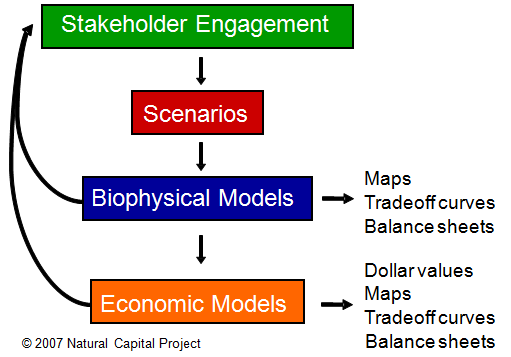
This article is definitely an "idea" article. They authors present a framework for how to actually achieve the laudable goal of monetizing nature in a way that can more easily make ecosystem services part of policy. They give some examples of land management in Hawai'i, and they mention a system they are working on called InVEST, which should help to actually achieve the goal, but I feel that for the most part this is (as advertised) a very conceptual paper. I like their framework for how the different parts of the process interact (i.e. where does biophysical science come in, where does social science come in, where does actual policy engineering come in, etc). It makes the whole thing seem very proceedural, which I find matches my own mental approach to these kinds of things, but does not represent the reality I'm coming to understand regarding ecological management: this is not a cycle between steps (ecosystems, services, values) but an interconnected web. Given that this is an idea paper, I suppose I would have liked a little more complexity in the ideas they've brought up, though perhaps that's not appropriate for a short Frontiers article. I don't have a good sense for how groundbreaking it is because I'm not familiar enough with the literature to know how much has been done to actually realize this kind of economic valuation of ecosystem services. They pitch it as if it is pushing the edge of the envelope - they point out that the concept has been around for a long time but that little progress has been made on the ground, and that they are trying to point the way. I think it does the job of pointing in a particular direction, though I suppose I am also not really surprised by the structure they come up with. It sounds a lot like many of our mind-maps on restoration from the last weeks, though more organized of course. Is it that we are at the cutting edge or is the field still really stuck on how to combine these different aspects of restoration and conservation?

Figure credit: the Natural Capital Project, on the download page for InVEST. http://www.naturalcapitalproject.org/InVEST.html

Modelling multiple ecosystem services, biodiversity conservation, commodity production, and tradeoffs at landscape salces


Nelson, E. et al. 2009. Front Ecol Environ 7(1): 4-11

This paper attempts to shift the focus of ecosystem services valuation from quantification of the current net value of ecosystem services toward prediction of the future services provided under alternate development scenarios. The authors propose the analytical tool InVEST (Integrated Valuation of Ecosystem Services and Tradeoffs), which models spatially explicit land-cover scenarios, as a method to evaluate benefits and tradeoffs between different values (e.g. commodity prices, biodiversity conservation, water quality, soil conservation, and carbon sequestration) to assist with region-wide planning.
In the case-study analyzed (Willamette Valley, OR) the Conservation option improved all values at higher rates than the other options, except the market value of commodities. Surprisingly, all of the scenarios enhanced biodiversity conservation above current levels. None of the options evaluated were extreme, due to the high value of conservation in Oregon and the area's long history of crop production which was viewed as highly unlikely to change drastically. I would expect that in other regions, such as the California Central Valley, the options would contain more stark contrasts and tradeoffs would become more apparent.
The authors did find that a development policy that focused solely on commodity prices disadvantaged ecosystem service provision and biodiversity, but that such trends were mitigated by policy options (such as payment for carbon sequestration) that incentivized conservation by private landowners. They advocate this method as a way to make the outcomes of different landuse options more transparent to stakeholders.
The authors utilized generalized measurements to build their models that were not regionally specific, thus there may be localized variables that were not accounted for that could be lost in such a coarse-grained analysis. While it was acknowledged that ecosystem services would not be evenly conserved across the landscape (due to isolation and intensification effects), the metrics used tended to homoginize effects for the region, again, potentially hiding the loss ecosystem services in particular locales within the study area.

Image Credit: United Nations Environment Programme